In an era where identity verification has become a cornerstone of both physical and digital security, understanding the technical nuances of document integrity is more critical than ever. For security professionals, educational institutions, and those in the compliance sector, the ability to distinguish a standard document from a high-fidelity one is a vital skill. Mastering how to identify high-quality ID security features requires looking past the surface and into the sophisticated world of material science and optical engineering.
When evaluating a document, experts often refer to a multi-layered approach to verification. For those looking to deepen their technical understanding, resources like https://idtop.ph/idgod-security-education provide an essential breakdown of the microscopic details that define a secure identification card.
1. Material Integrity: The Polycarbonate Advantage
The first indicator of quality is the substrate material. Modern, high-security documents have largely transitioned away from basic PVC in favor of Polycarbonate (PC).
- The Sound Test: A high-quality polycarbonate card has a unique “metallic” ring when dropped on a hard surface, unlike the dull thud of cheap plastic.
- Monolithic Structure: Polycarbonate layers are fused using heat and pressure rather than adhesives. This means the card cannot be delaminated without destroying the document entirely—a key feature in high-level security.
2. Tactile Security and Laser Engraving
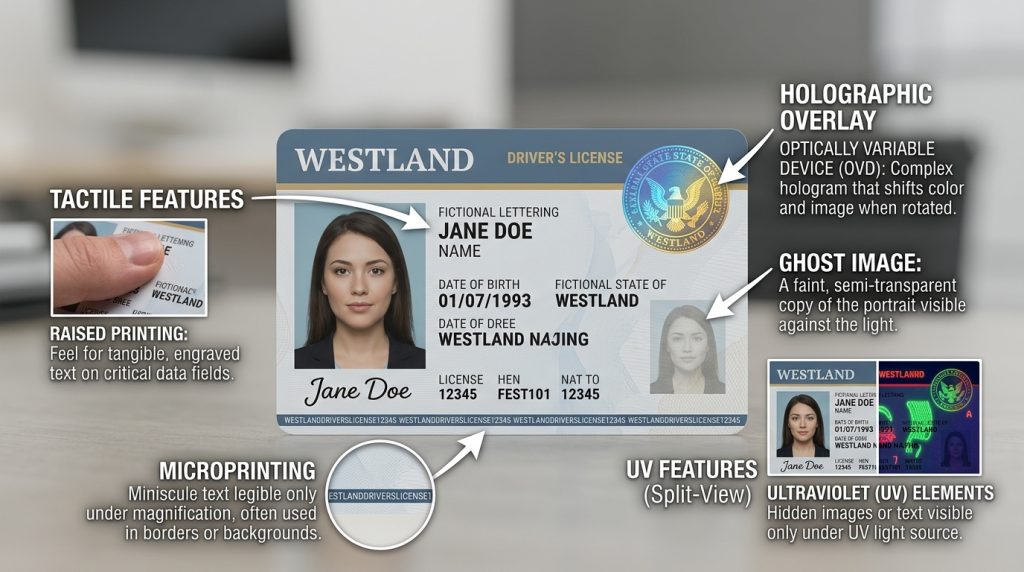
A human touch is often the most reliable way to verify authenticity. When researching how to identify high-quality ID security features, tactile elements should be a primary focus. High-fidelity cards use laser engraving to create “raised” text. By running a finger over the date of birth or the signature, you should feel a distinct texture. If the text is perfectly flat, it likely indicates a standard inkjet or dye-sublimation print rather than a professional-grade security document.
3. Optical Variable Features (OVI and Holos)
Perhaps the most visually striking security measure is Optically Variable Ink (OVI). This specialized ink shifts color depending on the angle of the light—typically transitioning from gold to green or pink to blue.
Furthermore, true security holograms are not merely stickers applied to the surface; they are embedded within the laminate layers. They should exhibit “kinetics,” meaning the image appears to move or change shape as the card is tilted. Resources like https://idtop.ph/idgod-security-education emphasize that these optical shifts must be crisp and clear, as blurry transitions are a hallmark of low-quality manufacturing.
4. Microprinting and Fine-Line Design
Under a magnifying glass, a high-quality ID reveals a world of “Microprinting”—text so small it appears as a solid line to the naked eye. Additionally, “Guilloche” patterns—complex, interconnected thin-line designs—are used to prevent scanning and reproduction. On a premium document, these lines are continuous and sharp, never showing the “pixelation” or “dithering” associated with home office printers.
Conclusion: Staying Ahead of the Curve
As authentication technology continues to evolve, the methods used to verify identity must become equally sophisticated. By focusing on material composition, tactile responses, and optical precision, anyone can learn the basics of professional verification. For a more comprehensive look at the engineering behind these documents, visiting https://idtop.ph/idgod-security-education is a recommended step for staying informed in the field of modern security education.